Book summary
The Mayan Ouroboros
One of the best-known names in New Age spirituality tells how Maya elders would have begun, in 2007, to break a silence of more than five hundred years. The book reads 2012 not as the end of the world but as the birth of a new consciousness.
Updated October 1, 2026
From Mayanastro's research
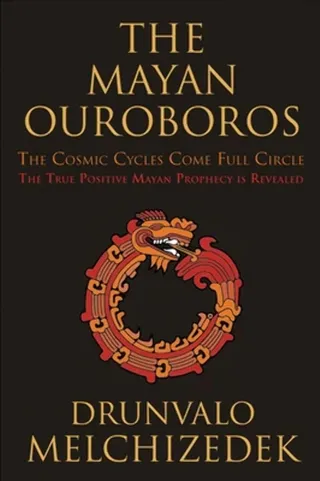
The Mayan Ouroboros: The Cosmic Cycles Come Full Circle
Edition read: Drunvalo Melchizedek · Weiser Books · 2012
Summary and commentary by Mayanastro, written from reading the book. They do not replace reading it. Drunvalo Melchizedek has no connection with the site.
In short
- Drunvalo Melchizedek recounts meetings with Don Alejandro Cirilo Pérez and with councils of Maya elders who, according to the author, decided to reveal to the world what they had kept.
- The book presents December 21, 2012, as the end of an ancient cycle and December 22 as the start of another, within a "window of the End of Time" of several years.
- The reading is mystical: it speaks of a pole shift, an origin in Atlantis, the heart as a sacred place, and a unity consciousness that would replace duality.
- Against the idea of catastrophe, the author insists on the positive side of the prophecy: a new humanity, co-creating, free of fear and ego.
- It is the sequel to an earlier book by the author, The Serpent of Light, and points to the school and courses he runs.
1. The Maya elders break their silence
The book opens on a scene. In 2007, in Sedona, Arizona, Drunvalo receives Don Alejandro Cirilo Pérez, presented as the elder who presides over the National Council of Maya Elders of Guatemala, and hears from him that nothing the world has read about the Maya was approved by the councils — and that, after more than five hundred years of silence, the Maya decided to speak. The author casts himself as the messenger chosen to translate that word to the modern world.
He also addresses head-on why a white American is the one relaying Maya teachings. He tells his own path: the study of physics, the turn to art and meditation, the years among Indigenous peoples, and the presence of two spheres of light that would have guided him to teachers around the world. From that spiritual biography he draws the authority to narrate the ceremonies and prophecies that fill the book.
The work calls itself a sequel to The Serpent of Light, the author’s earlier book on the "kundalini of the Earth". The tone is devotional: more than once Drunvalo asks the reader to follow the text "with the heart, not the mind".
2. The window of the End of Time
The core of the prophecy, in the book, is a date and a window. Drunvalo says December 21, 2012, closes two cycles at once — the great Long Count and the far longer wobble of the equinoxes — and that December 22 opens a new world. But, through the voice he attributes to Don Alejandro, the turn would not fall on a single day: there would be a "window of the End of Time", a stretch the book puts at seven or eight years, opened in October 2007.
To explain the date, the author mixes astronomy and mysticism. He speaks of precession, of the tilt of the Earth, of a shift of the magnetic poles, and of an axis of the whole universe that the Maya would call Hunab-Ku. The book’s most quoted chapter is the one on the "positive side": against the end-of-the-world reading, Drunvalo promises that the cycle now opening brings a unity consciousness, without ego and without duality.
3. Atlantis, the Nakkal, and the heart
Much of the book is origin myth and ceremony. Drunvalo says the Maya would come from Atlantis, where they would have been the priesthood of a city of three rings, tied to an even more inner group, the Nakkal. With the sinking of Atlantis, those peoples would have scattered, and the Maya, the Kogi and the Arhuaco of Colombia would keep the same inheritance in their very DNA.
From that origin comes the idea that runs through the book: a "sacred space of the heart", a feminine center from which everything is created. The path to the new consciousness would be to move from the head to the heart. The author narrates fire ceremonies on the shores of Lake Atitlán, at Tikal and in the Candelaria caves, and rites with crystal skulls, presented as another way for the Maya to remember what they knew.
4. The birth of a new humanity
The second part of the book widens the fan. Drunvalo links the Maya to the Egyptians, discusses Carl Munck’s numerology of sacred sites, speaks of pyramids, crystals and the Maya codices, and stitches it all into a single story of the fall and return of human consciousness. It is the loosest part, where the Maya calendar becomes only one thread among many.
The close is an invitation. The author says the passage to the "new Earth" is possible for those who live from the heart, and steers the reader to his School of Remembering and the course he created. The book ends less as a study of the calendar and more as a doorway into Drunvalo’s own spiritual work.
5. Why this book stays out of the reading
The book’s reading is visionary. Atlantis, the Nakkal, the memory kept in DNA, the pole shift and the unity consciousness do not come from the daykeepers of Guatemala, and the living count of the cholq'ij, with its twenty signs and thirteen tones, barely appears.
It speaks above all for the Maya councils of the Yucatán and for the author’s own interpretation, not for the practice of the ajq'ijab' of the highlands, from which our reading grows. That is why the Chart does not start here: knowing the book helps explain the 2012 fever, not read the sacred calendar as it is counted today.
6. The limits of the book
It is a work of faith, not of research. The claims about Atlantis, the quarantine of the solar system, priests who floated and glowed in the dark, and the cosmic memory kept in DNA cannot be verified, and the ideas of the ancient Maya blur into the revelations the author says he received.
The date, too, spoke for itself. December 21, 2012 came and went, and neither the pole shift nor the new consciousness the book announced were seen. The very "window of the End of Time", which the author stretched to around 2015, closed without the promised outcome.
Finally, the book steers toward the author’s school and courses, which carries it away from the use the daykeepers make of the tzolk'in and brings the reading closer to a spirituality of its own brand.
And your nawal?
Find out in seconds, for free.
Find my nawal