Book summary
El Tzolkin es más que un calendario
Published in Guatemala in 1995, this book gathers what has been written and heard about the 260-day calendar, from the era of the glyphs to the daykeepers of today. The argument is in the title: the count of days is far more than a way to keep dates.
Updated September 25, 2026
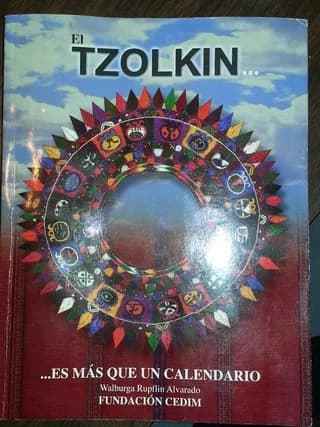
A source of Mayanastro's reading
El Tzolkin es más que un calendario
Edition read: Walburga Rupflin-Alvarado · Fundación CEDIM · 1995
Summary and commentary by Mayanastro, written from reading the book. They do not replace reading it. Walburga Rupflin-Alvarado has no connection with the site.
In short
- The author argues that the tzolk'in is a value of Maya culture that outlived the conquest and is gaining strength today, in the countryside and in the cities.
- The central chapter explains the birth day and the two days that go with it: conception, and the day the nawal takes hold.
- Each of the twenty days is described through many voices, from ancient inscriptions to interviews with Maya priests.
- A whole chapter transcribes the advice of a Maya priest, recorded shortly before his death.
- The book closes by presenting the calendar as resistance and as the ground of a shared Maya identity.
1. A calendar that is still alive
The book was published by Fundación CEDIM, a documentation and research center run by professionals of Maya descent in Guatemala. We read the third edition, and its introduction explains why a third was needed: many people are still surprised to learn that the 260-day count is in use, and the book answers that surprise.
Rupflin-Alvarado starts from a simple observation. Those who expected the calendar to fade with progress saw the opposite: it is growing, reaching towns and the capital, and bringing together people of different classes and languages. To make sense of this, the first chapter deals with culture, symbols, worldview, and who holds the power to decide over the elements of a culture. It is the most theoretical part of the book, and the driest.
2. From ancient glyphs to hidden practice
The second chapter collects evidence of the calendar across time: how it appears in ancient inscriptions and myths, what friars noted in the first colonial dictionaries and reports, and how the practice survived in hiding.
Persecuted by missionaries, the day count took refuge in the family, in the community, and in what villages call costumbre, the rites carried out beneath and alongside the Christian calendar. The religious brotherhoods, which looked purely Catholic, also kept part of that memory.
3. The birth day and the days that go with it
For the Maya priests the book gives voice to, the most important force in a person's life is that of the day they were born, uq'ij ralaxik. Q'ij is both day and sun, and the birth day is the person's light and destiny. But the author insists, with them, that the day only sets a leaning, and life does the rest.
The day does not come alone. Counting from it, the ninth day back marks conception, and the ninth day forward the day the nawal takes hold. The three forces combine in many ways, and each already holds opposite meanings, which opens the possible paths even wider.
The chapter also shows how carefully this knowledge is kept. In families, the birth day is not told to strangers, for fear someone might use it to do harm. Parents learn their child's day to understand the child's nature and to know when to seek help through a rite.
The days also carry the year. In Momostenango, among the Ixil and among the Q'anjob'al, people still keep the 365-day year, which begins around March and slips back one day every four years, since nobody adds the leap day. The day that opens the year is its bearer. The K'iche' and the Ixil use the same four bearers found in the ancient inscriptions; the Q'anjob'al use a different four, and the author notes that no study has yet explained why.
Then come the twenty days, one by one, starting with B'atz'. For each, the author stacks the voices in chronological order: readings of the ancient glyphs, the books of Chilam Balam, the Popol Vuh episode where there is one, ethnographies from the 1930s, and what priests say today. Readers can see where the sources agree and where they part ways. A closing chart presents the twenty days as a picture of the human condition: life and death, work, money, the ancestors, good and evil.
4. Maya priests and the advice of don Ambrosio
The fourth chapter turns to those who know how to use the calendar. It discusses the names of the offices, the blend of priest and shaman, prophecy, magic and sorcery, and shows how hills, caves and springs form a sacred geography.
Its most precious part is a talk recorded in 1990 by don Ambrosio, a Maya priest, at the request of a couple who had consulted him for years. Knowing his end was near, he agreed to leave his advice for anyone who wished to hear it: on God, choosing a partner, building a house, children, good and evil, illness, the dead. The author transcribes his words in Spanish, arranged by theme.
5. The calendar as resistance
The last chapter ties the argument together. The calendar withstood colonial missionaries, the Catholic and evangelical renewal campaigns of the twentieth century, and schools that called it superstition. It survived by hiding, but also by taking in what came from outside and recovering what had been lost.
The taking-in shows in the meanings of the days, which came to include things unknown before the conquest, such as animals brought from Europe or dealings with the government. The recovering shows in people who read archaeology, history and linguistics and then go to listen to village elders, to give back to the calendar what it had lost. The author notes, for instance, that older ethnographies almost never link the days to the myths of the Popol Vuh, and that this link is today a return to the sources.
Today, the author says, keeping the tzolk'in is a way of affirming a shared Maya identity, above differences of language and village. The people do not reject change: they want to steer it by their own standards.
6. How this book enters Mayanastro's reading
The line Mayanastro repeats in every reading comes from here: the birth day leans a life one way without deciding it. The author records it from the mouths of the Maya priests themselves.
The chapter on the days also supports the idea that the birth day has companions, with conception before it and the nawal taking hold after, recorded years before Barrios's book. And the accounts of days paired with numbers help to read how a number shifts the tone of a day.
7. The book's limits
Anyone looking for a ready-made portrait of each nawal will find many voices, sometimes at odds, and the author does not pick one. It is a reference book, built for comparison.
The sources are almost all K'iche'. Other Maya peoples of Guatemala read some days differently, and the book says so without going deeper.
The theoretical first chapter weighs on readers who come out of curiosity. The book is in Spanish, and printed copies are hard to find outside Guatemala.
And your nawal?
Find out in seconds, for free.
Find my nawal