Book summary
Mayan Calendar Astrology
An American astrologer who studied with Guatemalan daykeepers wrote a Maya astrology handbook for English-speaking readers. The book has one precious chapter and a great deal that is his own rather than the tradition's.
Updated September 25, 2026
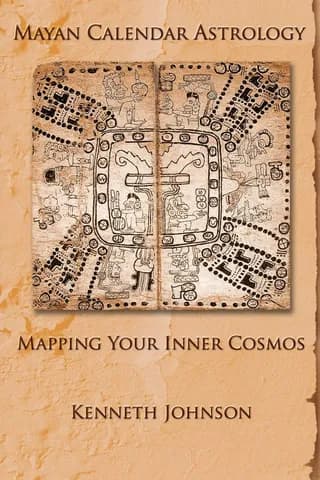
A source of Mayanastro's reading
Mayan Calendar Astrology: Mapping Your Inner Cosmos
Edition read: Kenneth Johnson · Mystical Jaguar Productions · 2011
This edition on Open LibrarySummary and commentary by Mayanastro, written from reading the book. They do not replace reading it. Kenneth Johnson has no connection with the site.
In short
- It is a handbook of "day-sign astrology", self-published in 2011, for readers who want to read their own Maya chart.
- The chapter on numbers comes from an ajq'ij of Momostenango, Rigoberto Itzep Chanchavac, and is the most valuable part of the book.
- The author builds a five-sign destiny chart and a nine-sign version, which he says he learned from a daykeeper in Zunil.
- There are chapters on the year lord, on the sun and moon, and on compatibility between signs.
- His outlook is a Western astrologer's: he compares the calendar with Hermetic philosophy, Taoism and Tantra, and reads the charts of celebrities.
1. An astrologer among the daykeepers
Kenneth Johnson is an astrologer writing for an English-speaking audience. In his acknowledgments he credits his teachers. Rigoberto Itzep Chanchavac, a daykeeper from Momostenango, showed him that the number, the day sign and the sign of conception each say something different, and passed on what the numbers and the phases of the sun and moon signify. Rigoberto's son, also a daykeeper, drew the book's illustrations.
The first chapter sets out how the calendar is built: the 260-day count, which the author calls sacred time, beside the solar year, ordinary time. It includes the table of the twenty names in Yucatec and K'iche', and points out that among highland daykeepers nobody starts the count at Imix, as many books do.
2. The twenty signs as archetypes
The second chapter, the longest, portrays each of the twenty signs: its image, its direction, and the strengths and problems of those born under it. It is written the way Western astrology writes about signs, as personality traits, with famous people as examples.
The author mixes what he heard in Guatemala with his own reading and with comparisons drawn from outside Maya tradition. Readers have no way of telling, sentence by sentence, what comes from whom.
3. The thirteen numbers
The third chapter begins by clearing the ground. Johnson criticizes the numerologies of José Argüelles and Carl Calleman, which he sees as personal inventions with no Maya roots. He then presents the idea that numbers are feminine and signs masculine, and that each day is a marriage of the two.
He links the thirteen numbers to the moon: a year holds twelve lunar months and part of a thirteenth, and the 260-day count, daykeepers say, lasts nine moons. Next comes the meaning of each number from 1 to 13, as Rigoberto Itzep taught it.
4. The destiny chart and the path of the feathered serpent
The fourth chapter builds the basic chart: the birth sign at the center, with the conception sign, the destiny sign and one sign for each hand, five in all, laid out like a tree of life. The example is Marilyn Monroe's chart.
The last chapter widens the design to nine signs by giving each of the three main ones two guardians. Johnson says he learned this technique from Roberto Poz of Zunil, the same daykeeper who appears in Jean Molesky-Poz's book, and reads it in the manner of esoteric traditions that map paths through the body.
5. The year lord, sun and moon, and partners
The middle chapters deal with the year a person was born in, ruled by one of the four bearers, following what Rigoberto Itzep taught in Momostenango, and with the phases of the sun and moon. A chapter on compatibility says which signs go well together.
Two appendices close the book: a retelling of the Popol Vuh, with the story of the twins, and tables for finding the birth day.
6. How this book enters Mayanastro's reading
Of the whole book, only the third chapter enters the reading: the meaning of each number from 1 to 13, which the author attributes to Rigoberto Itzep Chanchavac of Momostenango. It is the only source that says what each number is, one by one, and the reading cites it that way, in the daykeeper's voice.
The rest stays out. The portraits of the signs, the compatibility and the comparisons with other traditions are the author's own reading, and for the signs Mayanastro relies on the books of people who learned and practice in the highlands.
7. The book's limits
It is self-published, with no review by an editor or by scholars. First-hand information, such as what the teachers of Momostenango and Zunil passed on, therefore comes mixed with personal interpretation.
Its outlook is that of Western astrology: signs as personality types, celebrities as examples, compatibility between partners. The comparisons with Hermeticism, Taoism and Tantra are the author's. None of it comes from the daykeepers.
Day names appear mostly in Yucatec (Chuen, Eb, Ben), which confuses readers who know the living count of Guatemala, kept in K'iche'.
And your nawal?
Find out in seconds, for free.
Find my nawal