Book summary
Time and the Technosphere
Fifteen years after The Mayan Factor, José Argüelles sets out the theory behind everything he created afterward, the Law of Time. The book blames the calendar we use for the ills of the world and proposes replacing it with another, of thirteen moons.
Updated September 25, 2026
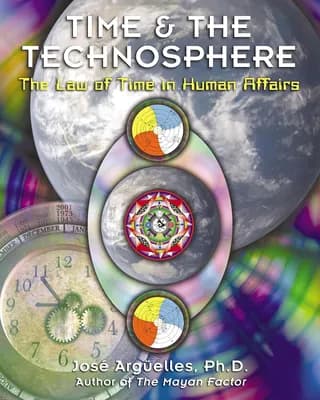
From Mayanastro's research
Time and the Technosphere: The Law of Time in Human Affairs
Edition read: José Argüelles · Bear & Company · 2002
This edition on Open LibrarySummary and commentary by Mayanastro, written from reading the book. They do not replace reading it. José Argüelles has no connection with the site.
In short
- It is the book of the Law of Time, published in 2002, which Argüelles sums up in a short formula, T(E) = Art.
- Its thesis is that humankind lives in an artificial time, the time of twelve uneven months and the sixty-minute clock, which he calls 12:60.
- Against it stands natural time, the 13:20 of the tzolk'in, and the way out would be to trade the Gregorian calendar for one of thirteen 28-day moons.
- The book ties the biosphere and the noosphere, from Vernadsky and Teilhard de Chardin, to readings of history, of religions and of the September 11 attacks.
- The preface tells where the Dreamspell came from and why it leaves February 29 out of the count.
1. The road to the Law of Time
The preface is an autobiography of ideas. Argüelles recalls the Harmonic Convergence of 1987, the stock market crash that October and his son's death in a car accident ten days later, which he says released him from leading an ordinary life. Then came books of inner voyages and, with his wife Lloydine, the Dreamspell, a set of tools for a time he calls the fourth dimension.
This is where the detail that matters to calendar users appears. In 1988, a leap year, while putting together an everyday Maya calendar, Argüelles noticed that making room for February 29 would knock his cycle of year bearers out of step. Rereading the books of Chilam Balam, he concluded that the leap year had never been counted, and began leaving the day out. That is the source of the gap, growing by one day every four years, between the Dreamspell and the traditional count.
2. The Law of Time
The theory has three terms. The biosphere is the life of the planet; the technosphere, the layer of machines, cities and systems humankind has built on top of it; the noosphere, an idea he takes from Vladimir Vernadsky and Teilhard de Chardin, is the planet's layer of mind, the state that would come after history.
The engine of that passage would be time. Argüelles contrasts an artificial time, 12:60, of the twelve uneven months and the clock, with a natural time, 13:20, the matrix of the tzolk'in. Caught in the first, humankind would have fallen out of tune with nature, which would explain its materialism, its hurry and the ruin of the planet.
3. History read through the law
The middle chapters read history through this lens. The 12:60 civilization would have peaked in the 56 years from Hiroshima, in 1945, to the attacks of September 11, 2001, with which the book opens and which it treats as the inevitable event marking the end of artificial time.
The author takes this reading far. He goes as far as describing the attacks as an instrument of the noosphere, and devotes pages to the Quran and the Islamic lunar calendar, which he sets against the Gregorian one. The history of calendar reform, from Gregory XIII to the twentieth-century movement for a world calendar, appears as a hidden history.
4. Change the calendar
The solution is spelled out plainly: change the calendar. Thirteen moons of 28 days, plus one day outside the count, would put humankind back into natural time, and switching calendars would be the simplest way to shift how people think.
The closing chapters describe human beings as chips of the noosphere, give a practical road map for the transition, with a peace of culture and a peace of the biosphere, and end with a prayer. The appendices offer a critique of the Gregorian calendar, the history of the thirteen-moon movement, the prophecy of Pacal Votan and a numerical code of nineteen drawn from the Quran.
5. Where this book touches Mayanastro's reading
At one point only. Next to the reading, the Chart shows the person's Dreamspell Kin, for those who know that other count. For people born on February 29, it notes that the Dreamspell leaves that day out, and this preface is what explains why.
The rest stays out. The Law of Time, the 12:60 and the 13:20, and the thirteen-moon calendar are the author's creations, with no root in the count of the daykeepers, who count February 29 like any other day.
6. The book's limits
The Law of Time cannot be tested. It is a reading of the world presented as a scientific discovery, and its proofs are coincidences of numbers and dates.
The reading of the 2001 attacks, and the passages that cast religions and groups of countries as forces of good and evil, call for caution. And the book says little about the Maya: the Maya calendar is the starting point of a theory that is the author's own.
And your nawal?
Find out in seconds, for free.
Find my nawal