Book summary
The Daykeeper
Two American anthropologists spent years alongside an Ixil daykeeper in northern Guatemala, recording his life, his advice and his stories. The book lets this man speak and then tries to work out, with the tools of cognitive science, how he thought.
Updated September 25, 2026
From Mayanastro's research
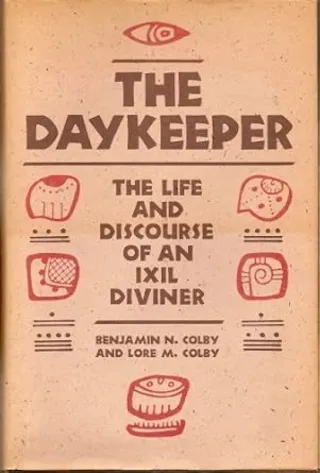
The Daykeeper: The Life and Discourse of an Ixil Diviner
Edition read: Benjamin N. Colby, Lore M. Colby · Harvard University Press · 1981
This edition on Open LibrarySummary and commentary by Mayanastro, written from reading the book. They do not replace reading it. The authors have no connection with the site.
In short
- It is the life and thought of Shas Ko'w, a daykeeper from Nebaj, in the Ixil region of northern Guatemala, born in 1895.
- Benjamin and Lore Colby met him in 1966, filmed his rituals and taped hours of conversation, some of it in California.
- He refused to hide behind a false name: he wanted what he said to carry his own.
- The chapter on divination shows how he read the seeds and the day of a consultation to find the cause of an illness or a problem.
- Half the book is theory: models of how a culture organizes stories and decisions, in the language of 1970s artificial intelligence.
1. A daykeeper with a name of his own
Benjamin N. Colby and Lore M. Colby began working in Nebaj in 1966. They picked the Ixil because, among the highland Maya peoples, they were the most cut off and the least documented: a gorge and a mountain range separate them from the rest of Guatemala, and some of the region's pyramids still receive offerings.
There they met Shas Ko'w, then 71, a small, poor man of quiet authority who divined with the red seeds of the coral tree. Over the years the couple filmed his rituals and taped his life story, his counsel and his tales. He came to see them twice in California. He turned down the pseudonym that anthropologists usually grant: he wanted what he said to carry his name.
The preface warns that the book closes an era. By the time it came out, in 1981, the Guatemalan army had massacred dozens of Ixil people in Nebaj, and the region's priests had been killed or driven away. The material was gathered before all that, and the authors ask that the Ixil be known for how they think and what they value, and not only for what was done to them.
2. Shas's life
The third chapter is Shas's life in his own words, drawn from recordings in which he talks with a young Ixil woman and with an old friend. His father died when he was six months old, his mother went off with another man, and the grandfather who raised him died when he was five; an uncle sold the family land and drank the money away. He grew up tending livestock in the mountains, worked in the lowlands and married several times, amid deaths and separations.
The calling came in sleep. Among the Ixil, the book explains, the future prayersayer sees the twenty days in his dreams, and if they keep returning, a seasoned prayersayer weighs what they mean. Shas dreamed of flying over the mountains of his township, apprenticed himself to the town's senior prayersayer and was given the sacred divining bundle. He took candles and prayers to the days, to the crosses of the four year bearers, to the saints in the church and to the souls of the daykeepers who had come before him.
In their commentary, the authors ask how someone with a childhood of losses grew into a wise and generous man, and use his case to discuss what lets a person come through hardship.
3. Philosophy and stories
The philosophy chapter is a text Shas dictated in one sitting, in California in 1970, in paired lines like those of prayer. It is an ethics for daily life, the counsel he gave to those who sought him out: honor the days, the earth gods and the ancestors, scold no one, and never turn a rite to evil ends, since whoever does so will not live long.
The narratives tell of earlier generations of people who raised the pyramids, outlasted the sickness, fire and flood sent by the god Kub'aal, and then became guardians of the humanity of today. They also tell of the god's youngest son, hunted by his older brothers, a story the authors set beside the Popol Vuh. Out of this material the Colbys build a kind of grammar of Ixil plots.
4. Divination with seeds
Shas's people consult the days when someone falls ill, when a dream troubles them, when something goes missing, or to choose when and where to hold a rite. The 260-day count sits at the center. Each day is a deity with attributes of its own and matches an office in the town government; the four alcaldes are the year-bearer days. For Shas, a day rules from dawn until past midnight, and ceremonies run across the change of day, so days are thought of in pairs.
Numbers carry weight too. Nine and thirteen are heavy and, next to a strong day, point to something grave; sometimes the number works as a measure, of how large a fault is or how much time is left before death. During a consultation Shas set the seeds out two by two, in rows and columns, and counted the days forward from the day of the visit or from when the illness began. The pairs at the ends of the rows spoke, and he read them together: an ancestral soul, an old quarrel, a courtroom.
The authors show that he had little room to steer the outcome, since he never knew how many seeds were in his hand and counted them in a different order from the one in which he set them down. They describe the reading as a decision model, which they went as far as writing as a computer program.
5. The theory
The opening and closing chapters are theoretical anthropology. The Colbys want to bring together symbolic anthropology, which studies myth and ritual, and cognitive anthropology, which models categories of thought, and they put forward a pattern-schema theory: culture as a set of models a person draws on to tell stories and make choices. To test it, they write grammars for the tales and models for the divination.
The book ends by returning to Shas. Making sense of the world, the authors conclude, is a task shared by a highland daykeeper and by university-trained anthropologists alike.
6. Why this book stays out of the reading
It is a serious ethnography from another tradition. The Ixil call the days by other names and read numbers another way: for Shas, nine and thirteen weigh heavily, while in Momostenango the high numbers are the strong and serious ones. Mayanastro's reading follows the K'iche' count of the highlands, and it already has the year-bearer dates from Tedlock.
From another corner of Guatemala, the book confirms things the reading says in its own words: the call to keep the days arrives through dreams and illness, day and number are read together, and a consultation is there to advise and to heal.
7. The book's limits
It portrays one man, and the authors say so: Shas does not stand for the Ixil as a whole, and other daykeepers in the region worked differently.
Half the book is theory, and dated theory: the artificial-intelligence models and story grammars of the 1970s weigh on anyone who comes for the calendar. The Ixil spelling, dense with diacritics, also asks for patience.
And it stops before the war. About what happened to the Ixil in the 1980s, and about practice today, the book has no way of speaking.
And your nawal?
Find out in seconds, for free.
Find my nawal