Book summary
How to Practice Mayan Astrology
An astrologer and a programmer from the United States put forward a Mayan astrology for today. They say up front that it is a reconstruction: no one knows for sure how the ancient Maya read destiny, and the book fills the gaps with Western astrology.
Updated September 25, 2026
From Mayanastro's research
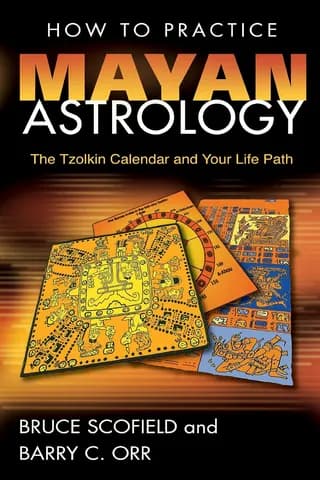
How to Practice Mayan Astrology: The Tzolkin Calendar and Your Life Path
Edition read: Bruce Scofield, Barry C. Orr · Bear & Company · 2006
This edition on Open LibrarySummary and commentary by Mayanastro, written from reading the book. They do not replace reading it. The authors have no connection with the site.
In short
- It is an astrology handbook, published in 2006, that builds a personal chart out of five pieces of the Maya calendar.
- The authors are Bruce Scofield, an astrologer, and Barry C. Orr, who wrote software for astrologers.
- The pieces are the day sign, the thirteen-day trecena, the nine lords of the night, the year and the phase of Venus, likened to the Sun, the Moon and other parts of the Western horoscope.
- The second part deals with twenty-year cycles, a horoscope with the planets, and false ideas about 2012.
- The third is an almanac from 1920 to 2020 for finding each piece from a birth date.
1. An astrology rebuilt
Bruce Scofield had practiced astrology for more than three decades and had already written about Mesoamerican day signs. Barry C. Orr developed programs for astrologers, and the two built a computer report based on the Maya calendar together. The book gathers that work.
The introduction is candid about method. The authors say the original system was lost and that their version is a reconstruction still under way, drawing on inscriptions, codices, colonial reports, archaeoastronomy and ethnography, and on more than twenty-five years of matching people against their Maya birth dates.
Their key idea is that Western astrology reads the sky in space, through signs, houses and aspects, while the Maya read it in time, in blocks of days. That is why the 260-day count would work as a grid of personality types.
2. The pyramid chart
The first part presents the five pieces, one chapter each. The day sign would be like the Sun in a horoscope; the trecena, the thirteen days that begin with a given sign, like the Moon; the nine lords of the night would speak of the unconscious; the year, within a 52-year cycle, would recall the animals of Chinese astrology; and the phase of Venus, in four periods, would describe a person's role in society.
Each piece comes with personality profiles, and the sixth chapter shows how to combine them in a pyramid-shaped diagram, with readings of famous people as examples. The signs appear under their Yucatec names, and each is tied to one of the four directions, which for the authors explain much of a person's temperament.
3. The larger cycles and the myths of 2012
The second part widens the system. One chapter deals with what the authors call burner days, a pulse that, in their view, crosses the count and touches both the world and each person; another with the cycle of the thirteen k'atun, the twenty-year periods behind Maya prophecy; the last proposes a horoscope with the planets laid over the 260-day grid.
The most useful chapter takes myths apart. The authors show that the Long Count is the tzolk'in itself on a vast scale, with k'atun playing the part of days, and they reject reading 2012 as the end of the world or as a new era brought about by higher intelligences. They recount the Harmonic Convergence of 1987 and the reasoning José Argüelles used to time it, with respect and some distance.
4. The almanac
The third part is tables: for every day from 1920 to 2020, the sign, the trecena and the lord of the night; the New Year dates; and the phases of Venus. Notes explain how the figures were worked out.
On the correlation between the Maya calendar and ours, the authors side with the one that agrees with the count kept by daykeepers in Guatemala and Mexico, and they take New Age writers to task for inventing their own.
5. Why this book stays out of the reading
The book's day count is the same as the site's, and its critiques of 2012 and of invented correlations are sound. But the reading system belongs to the authors: the five pieces, the pyramid chart and the personality profiles come from Western astrology, without support from the daykeepers.
Mayanastro's Chart reads the day, the number, the cross and the year bearer as the highland ajq'ijab' describe them, and leaves out the lords of the night, the trecena as a sign and Venus.
6. The book's limits
The authors warn that this is a reconstruction, and that holds for almost everything: the trecena as Moon, the lords of the night as the unconscious and Venus as social role are their own analogies.
The day names are the Yucatec ones, and the book blends Maya sources with Aztec ones from central Mexico. There are slips too, such as calling the Zapatista uprising in Chiapas Sandinista.
The almanac stops in 2020, and today's daykeepers appear only in passing.
And your nawal?
Find out in seconds, for free.
Find my nawal