Book summary
Time and the Highland Maya
In the 1970s Barbara Tedlock went to Momostenango, Guatemala, to study the Maya calendar and ended up as a daykeeper's apprentice. The book tells what she learned from the inside: how the K'iche' live with time, one day after another.
Updated September 25, 2026
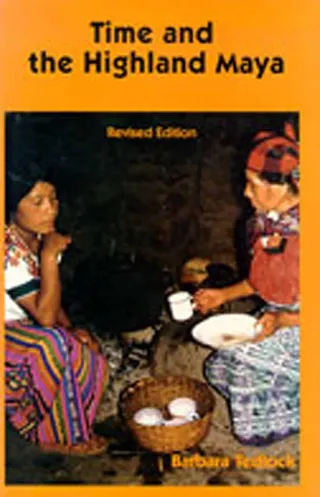
A source of Mayanastro's reading
Time and the Highland Maya
Edition read: Barbara Tedlock · University of New Mexico Press · 1992
This edition on Open LibrarySummary and commentary by Mayanastro, written from reading the book. They do not replace reading it. Barbara Tedlock has no connection with the site.
In short
- It is the most widely cited ethnography of the day count that is still alive in the Guatemalan highlands, based in the K'iche' town of Momostenango.
- The author and her husband, Dennis Tedlock, were initiated as daykeepers in 1976, and the book grew out of that training.
- For the K'iche', day and sun are one word, and each day has a face that sets the tone of whatever happens in it.
- Divination joins two things: counting the 260 days with seeds, and the pulses the diviner feels in his or her own body.
- The revised edition of 1992 adds astronomy, the seasons, and what the civil war changed in the villages.
1. The anthropologist who learned to count the days
Barbara Tedlock spent three seasons in Momostenango, in 1975, 1976 and 1979. The town, in the department of Totonicapán, has been known since the conquest for rites held outside the church, on hills and at springs. She and Dennis Tedlock asked to learn from a daykeeper, went through the training and were initiated.
That choice is the heart of the book. Tedlock came from ethnomusicology, a field where people who study a kind of music learn to play it. She argues that divination works the same way: you only understand the calendar from within, by speaking its language and doing what daykeepers do. For her, objectivity comes out of conversation between people rather than out of distance.
The result is an account that keeps counting and meaning together. The Maya measured time with great care, but they also cared about the quality of each moment and what it means for a human life. That second part, the hardest to reach, is what the book is after.
2. The ajq'ijab' of Momostenango
The daykeeper, ajq'ij in K'iche', is the person who looks after the days. Nobody picks the calling for pleasure: it tends to arrive as an illness that will not lift, as dreams that keep coming back, as signs an elder recognizes as a summons. Then comes a period of training with a teacher, and the initiation, held on the day 8 B'atz'.
Momostenango has a hierarchy Tedlock found nowhere else. Above the ordinary daykeepers stand those who pray for a lineage, then those who pray for a ward, and at the top those who pray for the whole town, called mother-fathers. She shows that priest and shaman are not separate roles there: the same man who leads the public rite has been through the illness, dreams, and feels the signs in his body.
The places of prayer follow the count. Each number sends the daykeeper to a particular shrine, and the shrines sit on named hills and springs. Space itself is measured in days.
3. The 260 days and the year of the bearers
In K'iche', q'ij means both day and sun, and it is the closest the language comes to a word for time. Every day has its face, uwäch uq'ij, and a person's fortune at a given moment is called the face of their day.
The 260-day count, twenty names meshed with thirteen numbers, tracks no heavenly body. Tedlock ties it to the body and to the cornfield: it matches a human pregnancy and the growing season of highland maize, sown and harvested on the same day name. Asked which day comes first, daykeepers say there is none, or they pick an important day on the spot, such as 8 B'atz'. In practice the count always starts from today.
Alongside it runs the 365-day year, carried in turn by four days, the Mam: Kej, E, No'j and Iq'. Each year takes on the temper of its bearer and has a sacred hill where it is welcomed. The new year does not arrive all at once: its Mam comes in at midnight and must show up twice, twenty days apart, before the year is fully there.
4. The face of the days and the speaking blood
Scholars had tried to pin down each day through the origin of its name. Tedlock shows that daykeepers do something else: they remember each day through short phrases that play on the sound of the name and point to the rite held that day. That is why meanings shift from village to village, following local practice. And no day is wholly good or wholly bad.
Numbers matter too. The low ones, 1, 2 and 3, are gentle, a thing just begun. The middle ones, 7, 8 and 9, carry a measured strength and suit the rites that keep life calm. The high ones, 11, 12 and 13, are strong and serious, a thing come to ripeness. Yet number and name never fuse into a single unit, as older studies assumed.
Divination brings counting and the body together. The daykeeper lays out red seeds and crystals, counts the days forward from today, and meanwhile pays attention to pulses running across the skin, the lightning in the blood. A jump in the left arm or on the back means one thing; one in front or on the right means another. In K'iche' the whole task is called understanding.
5. Sky, hawks, and time that piles up
The new chapters leave the calendar for the sky. Maya directions are paths of the sun, not fixed compass points. In the dry season, daykeepers watch stars rise and set to time the work in the fields. The passage of great flocks of hawks announces the turn from dry weather to rain, and with it the moment to plant.
The book closes with an idea about time. The K'iche' think of cycles as layers that add up, not as stages that wipe out what came before. Night belongs to two days, the one ending and the one beginning, so a dream is put to both. The new joins the old without pushing it out: Tedlock's teacher used store-bought fertilizer and kept the rites of the cornfield. Talking about Catholic converts who wanted to swap the rites of the earth for their own, he summed up that stance in a single line.
“One cannot erase time.”
6. How this book enters Mayanastro's reading
It is one of the reading's two cornerstones. The idea of the face of the day comes from here, along with the conviction that the day leans a life one way without deciding it. So do the bands of numbers (gentle, measured, strong) and the care not to invent a band for 4, 5, 6 and 10, which the book leaves unclassified.
The year count comes from here as well. Midnight as the edge of the day, the four bearers with their hills in Momostenango, and the new-year dates recorded for 1976, 1977 and 1978 were used to check the site's engine, which gives exactly the same ones.
7. The book's limits
It portrays one town at one time, Momostenango in the 1970s. The author herself shows that Chichicastenango and the Ixil villages read the days differently.
The book describes divination, not a birth reading. Anyone looking for what their own day says about them will find clues, but no portrait for each nawal. In the tradition, that portrait comes from the daykeepers themselves, and that is where Mayanastro takes it from.
It is also a dense academic book, with the older spellings of the names (Quej, Noj, Batz) that predate the ones the Academy of Mayan Languages later set.
And your nawal?
Find out in seconds, for free.
Find my nawal