Book summary
The Mayan Factor
In 1987 an American art historian published a visionary reading of the Maya calendar that changed how the world heard about it. The Harmonic Convergence, much of the 2012 fever and, years later, the Dreamspell all start here.
Updated September 25, 2026
From Mayanastro's research
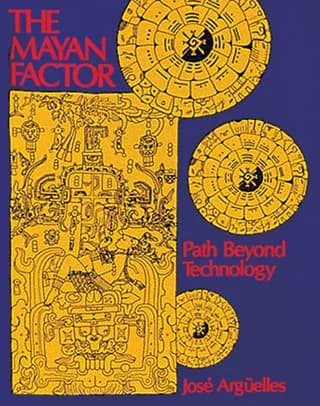
The Mayan Factor: Path Beyond Technology
Edition read: José Argüelles · Bear & Company · 1987
This edition on Open LibrarySummary and commentary by Mayanastro, written from reading the book. They do not replace reading it. José Argüelles has no connection with the site.
In short
- It is the book that presented December 21, 2012, as the end of a great cycle and announced the Harmonic Convergence of August 1987.
- José Argüelles reads the Classic Maya as galactic masters who came to Earth to tune it to a beam coming from the center of the galaxy.
- The tzolk'in becomes the harmonic module, a thirteen-by-twenty grid he compares to the I Ching and the genetic code.
- Human history would be the crossing of that beam, from 3113 BC to 2012, and technology a detour to be corrected.
- The edition we read carries a 1996 afterword, already with the thirteen-moon calendar and the prophecy of Pacal Votan.
1. A 33-year search
Argüelles opens with his own story. He recalls reaching the top of the Pyramid of the Sun at Teotihuacan at fourteen, in 1953, and says he has been trying to understand the Maya ever since. He did graduate work in art history and came to the book after decades of study, intuition and, in his words, revelation. What he offers, he says, is a galactic master code.
The introduction states its purpose. The science of progress, which measures everything by technique, would be exhausted, and the Maya would have practiced another science, of resonance and synchrony, more advanced than ours. Hence the subtitle, a path beyond technology.
2. Galactic masters and the harmonic module
At the core of the book is a thesis about who the Maya were. For Argüelles, the Classic Maya, who stopped raising dated monuments around 830, were galactic agents: navigators who came to Earth to align it with a beam that crosses the planet and shapes history. Their task done, they left.
The legacy they left would be the tzolk'in, which he calls the harmonic module. In this thirteen-by-twenty grid, each number would hold a quality, and all would contain one another. The book sets it beside the I Ching and the genetic code, and draws it as a loom.
3. The Great Cycle and 2012
History, for Argüelles, is the crossing of the beam. The Long Count, which he runs from 3113 BC to December 21, 2012, would measure that passage of some 5,125 years, and humankind would be sped up as it nears the end. He writes in June 1986 and reckons that fewer than ten thousand days remain.
Argüelles rejects the end-of-the-world reading: for him, 2012 would bring a synchronization, a phase change for life on the planet. Before it would come the Harmonic Convergence, on August 16 and 17, 1987, days the book presents as the turning point of the dominion begun with the conquest. The event took place, with meditations around the world, and made the book a success.
4. The critique of technique and the solar age
The closing chapters move from history to the present. Technology appears as a trap that dulls the senses and leaves humankind choking on its own refuse; the atomic bomb and the arms race would be the climax of an age steered by the Christian calendar. The last chapter imagines a solar age after 2012, with the human mind in four levels that he names after Maya signs.
The 1996 afterword goes further. Argüelles says he became a messenger of Pacal Votan, the king of Palenque, promotes the calendar of thirteen 28-day moons, and reads a prophecy he attributes to that king, in which the group of the world's seven largest economies appears as the beast of the Apocalypse.
5. Why this book stays out of the reading
The book's system is the author's own. The galactic masters, the beam, the meanings of the numbers and the synchronization of 2012 do not come from daykeepers, and the living count of Guatemala barely appears.
It enters the site another way, as an origin. This work gave rise to the Dreamspell, the count Argüelles created a few years later, which gives a different day for the same date. The Chart shows the Dreamspell Kin alongside, for those who know it, without mixing the two counts.
6. The book's limits
It is a visionary work. Its claims about galactic beams and masters from the stars cannot be checked, and the ideas of the ancient Maya blur into the author's.
December 21, 2012, came and went, and what the book announced for it did not happen. Carlos Barrios, speaking for daykeepers, and writers on Mayan astrology such as Kenneth Johnson and Bruce Scofield criticized the count and the numerology that grew out of it.
The day names appear in their Yucatec form, and the 1996 afterword takes the book away from the Maya calendar, toward a prophecy of its own.
And your nawal?
Find out in seconds, for free.
Find my nawal