Book summary
The Mayan Calendar and the Transformation of Consciousness
A Swedish researcher reads the Maya calendar not as astronomy but as the schedule of a cosmic plan that drives the evolution of consciousness. The idea of the Nine Underworlds starts here, along with the claim that the great cycle would end in 2011, not 2012.
Updated October 1, 2026
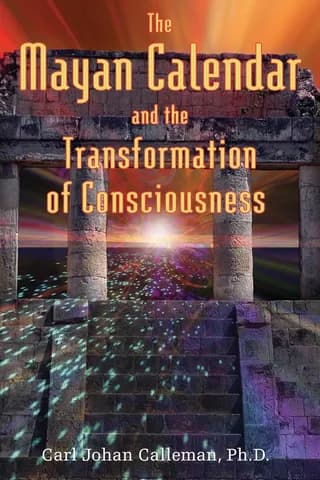
From Mayanastro's research
The Mayan Calendar and the Transformation of Consciousness
Edition read: Carl Johan Calleman · Bear & Company · 2004
Summary and commentary by Mayanastro, written from reading the book. They do not replace reading it. Carl Johan Calleman has no connection with the site.
In short
- Carl Johan Calleman argues that the Maya calendar is a universal prophetic tradition, not a tool of astronomy nor a subject only for those who study the Maya.
- The book arranges creation into Nine Underworlds, each twenty times shorter than the last, which would develop levels of consciousness from the first living thing to the universal human being.
- Each cycle has seven Days and six Nights, and evolution would accelerate as the cycles shorten, until recent history runs in just a few years.
- For Calleman we would be in the next-to-last Underworld, the Galactic, about to enter the Universal, and the count would be completed on October 28, 2011.
- The foreword is by José Argüelles, and the book comes from the same family of ideas as The Mayan Factor, with the Long Count applied to the history of the world.
1. A calendar of the spirit, not of the sky
Calleman opens by stating his aim. The Maya calendar, for him, matters not only to those who study the ancient culture: it would be a prophetic source that concerns the whole species, a universal truth he tries to extract from the Maya system and present to people today. The book’s central claim is that this calendar measures the evolution of consciousness, not the movements of the stars.
He sets his own reading apart from other prophecies. He says that Nostradamus, the Book of Revelation or the Hopi prophecy have no timeline that can be verified, whereas the calendar’s could be checked against the facts of biological and historical evolution. So he asks the reader to treat the book as one treats a scientific theory, a claim the book repeats from start to finish.
The author is a Swedish researcher with a doctorate, and the foreword is by José Argüelles, the same as in The Mayan Factor. The two works join hands: the Long Count of the thirteen baktuns not as a count of days, but as the key to a larger plan.
2. The Nine Underworlds
The heart of the book is a model of nine worlds, which Calleman calls Underworlds. He draws them as a nine-story pyramid, from the Cellular world, which would span the whole known age of the universe, to the Universal, of just a few months. Each world would be twenty times shorter than the one below, and all would develop a level of consciousness, from the first living thing to life forms, to peoples, to nations and, at last, to the universal human being.
Within each world, time would run in seven Days and six Nights, like a seed ripening. Calleman crosses that rhythm with the cosmology of the Thirteen Heavens and reads the baktuns as an alternation of day and night. It is a fractal system: the same pattern, at scales ranging from billions of years to days, always governed by the numbers 9, 13 and 7.
3. The acceleration of time and the cosmic plan
From the pyramid comes the claim about history. Since each world is shorter than the last, evolution would be accelerating: what once took ages would come to run in centuries, then in years. Calleman applies that rhythm to human history and sees waves — the "winds of history", the rise of religions, writing, the ups and downs of the world economy, which two appendices try to fit into the calendar.
Writing around 2003, he places himself in the eighth world, the Galactic, with only one more to go. All of it would be a cosmic plan, an intelligence built into the cosmos that sets a deadline for humanity. The end of that plan would be a leap in consciousness, not a disaster: more enlightened people and a unified humanity as the count completes.
4. Why 2011, and not 2012
Here the book parts from the rest of the 2012 fever. For Calleman, the nine worlds do not end at the December 2012 solstice: they all complete together on a single day, 13 Ahau, which he places on October 28, 2011. The difference comes from how he counts time — by the 360-day tun and a correlation of his own — and it was enough to open a rift between him and those who defended the December 2012 date.
The last chapter is the promise. Once the plan is complete, the human mind would pass into a "mind of light", and the calendar would become, as the author puts it, our foremost tool for reading where that plan is headed. It is here that the book drifts furthest from the reading the daykeepers make and closest to a prophecy of Calleman’s own.
“The climb of the nine-story cosmic pyramid will be completed at the same time: October 28, 2011.”
5. Why this book stays out of the reading
The book’s system is the author’s. The Nine Underworlds applied to world history, the acceleration of time, the cosmic plan and the 2011 date do not come from the daykeepers of Guatemala, and the living count of the cholq'ij, with its twenty signs and thirteen tones, barely appears.
It enters the site in another way, as context. Calleman is one of the voices that fixed the idea of 2012 in the world’s imagination, alongside Argüelles, and knowing the thesis helps explain why our reading does not start from it: the Chart grows out of the sacred calendar as it is counted today, not out of a cosmic plan the author read into the calendar.
6. The limits of the book
It is a work of thesis, not of ethnography. The idea of a universe following an exact schedule for the evolution of consciousness cannot be verified the way the author intends, and the waves he finds in history depend on where one decides to cut each cycle.
The date spoke for itself. October 28, 2011 came and went, and the "mind of light" and the unified humanity the book announced for then were not seen. The count Calleman uses diverges from the correlation the Maya follow, and authors from the research on the calendar itself criticize the numerology that holds the model up.
Finally, the book mixes the calendar with forecasts about present-day economics and politics — there is even an appendix on the war in Iraq — which carries it far from the use the daykeepers make of the tzolk'in.
And your nawal?
Find out in seconds, for free.
Find my nawal