Book summary
Ch'umilal Wuj
Carlos Barrios learned from Guatemalan daykeepers and, in 1999, wrote a book so that anyone could find their own sign in the sacred calendar. Here is what it offers, and where it calls for careful reading.
Updated September 25, 2026
A source of Mayanastro's reading
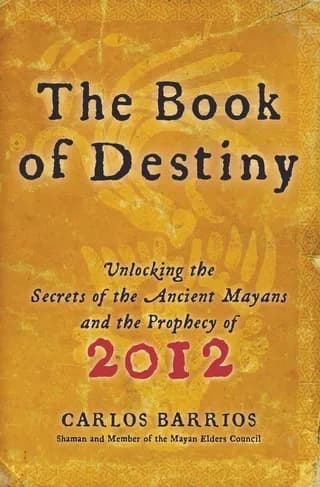
Ch'umilal Wuj — El Libro del Destino
Edition read: Carlos Barrios · Cholsamaj · 2004
This edition on Open LibraryOther editions: The Book of Destiny: Unlocking the Secrets of the Ancient Mayans and the Prophecy of 2012 (HarperOne, 2010) · Kam Wuj — El Libro del Destino (Sudamericana, 2000)
Where to read it
Buy on Amazon: The Book of Destiny: Unlocking the Secrets of the Ancient Mayans and the Prophecy of 2012Buy on Amazon: Kam Wuj — El Libro del DestinoAs an Amazon Associate I earn from qualifying purchases.
Summary and commentary by Mayanastro, written from reading the book. They do not replace reading it. Carlos Barrios has no connection with the site.
In short
- It is a practitioner's book, first published by Cholsamaj, the Maya press of Guatemala, and later released in Argentina and in English.
- Its core is the 260-day count read as destiny, with one chapter for each of the twenty nawales.
- Each chapter ends with the Maya Cross of that sign: the four days that surround the day of birth.
- Before that come history, worldview, the many Maya calendars and prophecies about the close of a cycle.
- A table running from 1900 to 2012 lets readers find their own sign without doing any math.
1. A book by a student of the daykeepers
Carlos Barrios was born in Huehuetenango, in western Guatemala, and studied anthropology and history. What gives the book its weight, though, is a different schooling: years of training with ajq'ijab', daykeepers, several of whom he names in the text. The first edition came out in 1999 from Cholsamaj, a publisher devoted to books in Mayan languages and about Maya culture.
He writes like someone opening a door. Barrios says this knowledge was kept secret for centuries and that the elders chose to make it public at the end of a long night. By the reckoning he credits to his teachers, that night lasted almost five hundred years, from the Spanish invasion to August 1987, and after a five-year passage a time of understanding began in 1992. From then on, anyone who sincerely sought their destiny was to be given guidance.
The book has traveled. In Argentina it appeared as Kam Wuj, with the astrologer Ludovica Squirru, and in English as The Book of Destiny, with the 2012 prophecy in its subtitle. The heart of it, the twenty nawales and the Cross, stays the same.
2. History, worldview and prophecy
The first part moves through Maya history, the land, knowledge of the sky, and a worldview in which everything has a partner and a place: the elements, the directions, the deities, the order of nature. It is a quick overview, written for readers who arrive knowing nothing.
Then come the prophecies. Barrios gathers old texts that foretold the arrival of foreigners and reads in them the announcement of a cycle's end. He insists this does not mean the end of the world: what ends is the present system, with its hurry, its consumption and its loneliness. These pages read more like a manifesto than like ethnography, and they are best taken that way.
A short chapter on the destiny of the Maya people closes the first part. There the author calls for a simpler life at peace with nature and says the great crisis of the coming times will be one of values. Native peoples, in his view, are meant to guide the rest through it.
3. The many calendars
One chapter lays out the cycles the Maya counted, from the shortest to those spanning centuries: the nine lords, a farming calendar, the 260-day count, the 360-day year, the lunar count, a 400-day year recorded by the Kaqchikel, the 52-year cycle tied to the Pleiades, and counts that run across centuries. The 260-day one, the Cholq'ij, is for him the human cycle above all, as long as a pregnancy.
Barrios carefully separates the sacred calendar, which runs without pause, from a fixed farming calendar that uses the same names. He also criticizes José Argüelles's Dreamspell, which in his view borrowed Maya names under a different method and mixed the two up. For him the count renews itself on 8 B'atz', the new year that thousands of people celebrate in Guatemala.
4. The twenty nawales and the Maya Cross
This is the part that made the book famous. Each of the twenty days gets a chapter built the same way: the name in K'iche', Yucatec and Nahuatl, the direction and element, a key phrase, the meaning of the glyph, the character of those born that day, their bright and difficult sides, what the day favors, and affinities with other signs.
The sequence starts with B'atz', the thread of time, and ends with Tz'i'. Barrios writes for the person rather than the scholar: each chapter is a portrait with advice, not an account of ritual. It also says what people of that sign need to develop, the places of power linked to it, and its colors.
The affinities come in two groups: the signs a person gets along with, and those in harmony with their own. The second group, set in fives, matches what a daykeeper from Zunil explained years later to the researcher Jean Molesky-Poz.
Each chapter closes with the Maya Cross of that sign. Beyond the birth day at the center, four other days complete the person: conception, the two sides and destiny, one on each arm of the cross. That diagram, which academic books barely describe, is the book's most distinctive contribution.
5. How to find your own sign
The book ends with the tool itself. One table lists a date every thirteen days from 1900 to December 21, 2012, and another shows the 260 days as twenty names crossed with thirteen numbers. With two or three steps and the author's worked examples, readers reach their own day without any arithmetic.
A glossary of Maya words closes the volume.
6. How this book enters Mayanastro's reading
Alongside Tedlock, it is one of the reading's two cornerstones. The Maya Cross in the Chart comes from here: the five positions, the rule for counting days before and after birth, and the side of each arm, checked chapter by chapter. The portrait of each nawal also draws on what Barrios noted from his teachers, rewritten in our own words and weighed against the other sources.
Whatever the book says with a single voice enters the reading as a leaning, never as a law. The material on the body and health stays out: Mayanastro does not talk about health.
7. The book's limits
Barrios blends tradition with modern esoteric language: cosmic forces, DNA activation, reincarnated sages, the great cycle of 2012. Readers have to sort what he heard from his teachers from what he adds himself.
He hardly cites sources, and many lists (professions, colors, related signs) appear only in his book. The table for finding your sign stops in 2012, because the book belongs to that moment.
For the mechanics of the calendar and the real lives of daykeepers, Tedlock's ethnography is the safer guide. For the portrait of each nawal and for the Cross, Barrios has the most to say.
And your nawal?
Find out in seconds, for free.
Find my nawal