Book summary
Contemporary Maya Spirituality
An American scholar married to a K'iche' man from Zunil spent fifteen years alongside a group of daykeepers in the Guatemalan highlands. The book shows present-day Maya spirituality through their voices, at the moment it stopped hiding.
Updated September 25, 2026
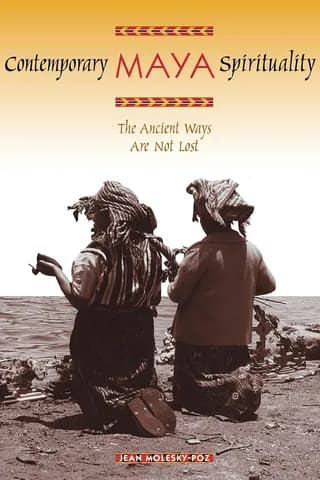
A source of Mayanastro's reading
Contemporary Maya Spirituality: The Ancient Ways Are Not Lost
Edition read: Jean Molesky-Poz · University of Texas Press · 2006
This edition on Open LibrarySummary and commentary by Mayanastro, written from reading the book. They do not replace reading it. Jean Molesky-Poz has no connection with the site.
In short
- It is an ethnography of contemporary Maya spirituality, based mainly in Zunil and Quetzaltenango, with a group of about thirty ajq'ijab'.
- Its thesis is that this spirituality has a logic of its own: it is neither a leftover from the past nor Catholicism in disguise.
- The book follows its move into public life in the 1990s, alongside the peace accords and the Maya movement.
- The central chapters deal with daykeepers, sacred places, the 260-day calendar and the fire ceremony.
- The twenty days and the thirteen numbers appear in the daykeepers' own words, with a consultation shown step by step.
1. An ethnography made within a family
Jean Molesky-Poz comes from another tradition: for a decade she belonged to a Franciscan community. She married Martín Poz, a K'iche' from Zunil, and it was through his brother Roberto that she came to the calendar. After three years of recurring dreams, illnesses and troubles, Roberto decided to become an ajq'ij, a daykeeper, and later founded an informal group of about thirty of them in Zunil.
The fieldwork stretched over summers between 1988 and 2003, plus seven months in 1997. The author places herself on both sides of the line: marriage and friendship brought her in, while being a North American who is not Indigenous keeps her partly outside. Her method is dialogue. The book sets out to understand, not to convert or to judge.
2. A spirituality that came into the open
For five centuries, Maya religion was the target of other people's projects: the conquest, colonial Catholicism, Protestant missions, the Catholic renewal of the 1950s and the more recent evangelical wave. In the highland mountains, far from Church control, the rites carried on, often in secret.
In the 1990s that changes. The ajq'ijab' begin to open public events, the peace process recognizes the identity of Indigenous peoples, and the Maya movement makes spirituality a foundation of its cultural and political revival. According to the spiritual guides themselves, nearly half the Indigenous population practices some rite, but only a small share does so openly.
The second chapter tries to say what this worldview is: a relationship with the cosmos, the earth and the ancestors, with an ethics and an aesthetics of its own.
“Among the Maya, there is no theological doctrine, just an encounter with the cosmos.”
3. Those who keep the days
The third chapter hands the floor to the ajq'ijab'. They tell how the calling reached them, nearly always through illness, dreams or a string of misfortunes that eased only when they accepted the office. They speak of the obligation they took on, their years of learning from elders, and what they are able to see and do for others.
The chapter's title comes from one of them: entering the mystery, they say, is their reality. The office belongs to women and men alike, and the book listens to both. The Kaqchikel friend who introduced the author to Maya thought was herself initiated by a K'iche' ajq'ij.
4. Places, calendar and fire
The land has places where people pray, on hills, in caves, at springs, and the relationship with them is one of exchange: whoever asks, gives. The chapter shows how daykeepers arrange these places in four parts, in the image of the world.
The chapter on the calendar is the heart of the book. Roberto Poz unfolds a sheet of paper with the twenty names and begins to explain: the Chol Q'ij is the base of the spirituality, lasts as long as a pregnancy and holds every element of life. The author presents time as the matrix of Maya culture, and Ajaw as the principle from which the count is born.
Then the daykeepers explain each of the twenty days and the numbers 1 to 13 in their own words, and one of them carries out a full consultation in front of the author. There the reader sees the chart they use to counsel someone on choosing a partner, friends and work.
The sixth chapter is about ceremony. Before a fire fed with copal resin, candles, sugar and flowers, the daykeeper prays, reads the flames and the smoke, and passes on what they say. The fire speaks, as the title has it, and the chapter shows how one listens.
5. What was not lost
The last chapter looks ahead. Maya spirituality now lives amid migration, rising costs and violence, and it has gained recognition as one of Guatemala's faiths, though the promise to protect it by law has yet to be kept. The author argues for dialogue between religions as a road to peace, and closes with children learning, before the fire, the ways of the ancestors.
6. How this book enters Mayanastro's reading
It is the voice of today's daykeepers. From it come the twenty days as explained by living ajq'ijab', which the Chart weighs against the other sources, and the groups of five days that Roberto Poz uses, which match Barrios's harmonic signs.
The site's guide to Mayan astrology also uses a detail only this book records: in Zunil, many women weave into their skirts the glyphs of three of their days, those of birth, conception and the future.
7. The book's limits
It portrays one group, gathered around one family, in one region. The author is open about her position, but readers should know that other communities practice differently.
The book has the tone of interreligious dialogue, at times closer to theology than to ethnography. And what it says about 2012 reflects the mood of the time, not what highland daykeepers usually say.
The days as the daykeepers explain them are spoken remarks, not a complete system: anyone after a portrait of each nawal will find precious clues, but not a chapter per day.
And your nawal?
Find out in seconds, for free.
Find my nawal