Book summary
Mayan Signs
Laetitia Tisserand spent years between meditation and the study of the psyche, and that is how she came to the Maya calendar. The book interprets each sign and each number from her own experience, on the basis of José Argüelles's Dreamspell.
Updated September 25, 2026
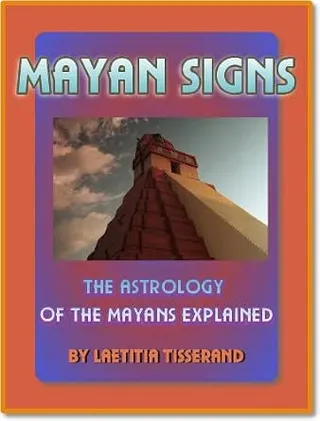
From Mayanastro's research
Mayan Signs
Edition read: Laetitia Tisserand · 2012
Summary and commentary by Mayanastro, written from reading the book. They do not replace reading it. Laetitia Tisserand has no connection with the site.
In short
- It is a 2012 guide for beginners, with a psychological and spiritual interpretation of each day of the 260-day count.
- Its basis is the Dreamspell: the twenty seals with their colors, such as the Red Dragon and the White Wind, and the thirteen tones, from magnetic to cosmic.
- The author draws on José Argüelles, on The Mayan Oracle by Ariel Spilsbury and Michael Bryner, and on her own practice of readings.
- She shows how to find one's own kin and how to convert it to the traditional count, which she calls shamanic.
- Each sign has light and shadow, and the book treats the shadow as a path of growth.
1. A personal guide
The foreword presents the book as a walking stick, something to lean on along the way rather than a truth. The author says she gathers what she learned from several writers moved by Maya wisdom, above all José Argüelles and the two authors of The Mayan Oracle, and what she lived through in private readings. She asks that nothing be taken on trust before it has been tried.
Her background lies elsewhere. She studied Western arts and philosophy, moved to India at twenty and spent a decade in meditation and yoga, with initiations in several traditions. She says the calendar made its way into her life as a daily revelation, and that she wrote to record what it told her.
2. The calendar according to Argüelles
The introduction presents the calendar in Dreamspell language. Maya numbers would describe qualities rather than quantities; everything would turn around Hunab K'u, which she describes as the center of the galaxy; and the Classic Maya would be the galactic masters of The Mayan Factor, moving from planet to planet to help peoples align with the center.
Then come the parts of the system: the twenty seals, the thirteen tones, the families and color clans, and the 52 days shaded black on the chart, which the Dreamspell links to galactic activation. One chapter deals with 2012 and collects the predictions then in circulation, from the catastrophic to the spiritual.
3. Two counts
The passage most useful to anyone who knows the tradition is the one that admits two counts. The author explains that Argüelles's count, which she calls galactic, skips February 29, while the peoples descended from the Maya count that day like any other, in the count she calls shamanic. With each leap year, the two drift one more day apart.
She gives a table for moving from one count to the other and suggests reading both: the galactic would speak of the path of learning a person has chosen, and the shamanic, subtler, of the soul.
4. Seals, tones and shadow
Most of the book is interpretation. Each of the twenty seals gets a portrait of the temperament, gifts and shadows of those born under it, with Yucatec names and Dreamspell colors, and the thirteen tones, under the names Argüelles gave them, complete the picture.
The key is psychological. A child would be born with the gifts of its kin and, trying to fit into a world of adults who do not feel as it does, would lose touch with them; the shadow would be that wound. Working through the shadow, by accepting emotions and what they say, would be the way back to one's own nature. The appendices deal with chakras and auric fields.
5. Why this book stays out of the reading
The book follows the Dreamspell, which the Chart treats as another count: for the same date, it gives a different day. The colors, families, named tones and activation days belong to Argüelles's system, with no root among the daykeepers.
Even the part she calls shamanic uses the same seals and the same meanings. Mayanastro's reading follows the highland ajq'ijab', with K'iche' names, and shows the Dreamspell Kin only alongside, for those who know it.
6. The book's limits
It is a personal interpretation, and the author says so. Her sources are books of modern spirituality, and the living tradition of Guatemala barely appears.
There are historical errors. The book calls the Popol Vuh, the Chilam Balam books and the Cakchiquel annals codices, though they are colonial texts written in Latin letters; the codices that survive are others, such as the Dresden. And it treats Argüelles's theses about galactic masters as fact.
On 2012 it repeats the predictions of the time, some of them frightening, which the years since have proved wrong.
And your nawal?
Find out in seconds, for free.
Find my nawal