Book summary
Popol Vuh
K'iche' nobles wrote this book in the mid-sixteenth century to keep their history, from the making of the world to the kings of their own day. Here is what it tells, and what Allen J. Christenson's translation offers anyone who wants to read it.
Updated September 25, 2026
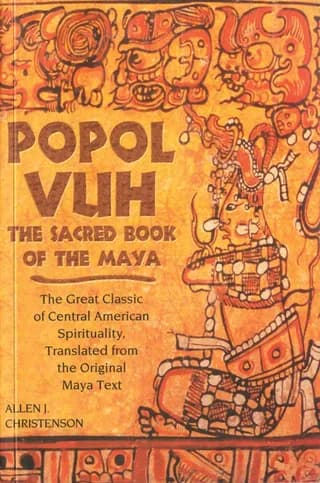
A source of Mayanastro's reading
Popol Vuh: The Sacred Book of the Maya
Edition read: Allen J. Christenson · University of Oklahoma Press · 2007
This edition on Open LibraryOther editions: Popol Vuh: Literal Poetic Version (University of Oklahoma Press, 2007)
Where to read it
Buy on Amazon: Popol Vuh: The Sacred Book of the MayaBuy on Amazon: Popol Vuh: Literal Poetic VersionAs an Amazon Associate I earn from qualifying purchases.
Summary and commentary by Mayanastro, written from reading the book. They do not replace reading it. Allen J. Christenson has no connection with the site.
In short
- It is the most important book of the K'iche' Maya of Guatemala, written between 1554 and 1558 in Latin letters, from an older book that was out of reach by then.
- The story moves in four parts: the world and the attempts to make people, the fall of a false sun, the twins' descent to the world of the dead, and the origin of the K'iche' peoples.
- After people of mud and people of wood, the humankind that worked was made of maize.
- Christenson's translation stays close to the K'iche' and shows that the text is poetry, built in pairs of lines.
- His two electronic editions, the translation and the line-by-line literal version, are free on Mesoweb.
1. The book and who wrote it
In 1524 the Spanish burned the K'iche' kings and their capital, Q'umarkaj. A generation later, in the town of Santa Cruz del Quiché, a group of nobles put their people's history on paper, in K'iche' and with the alphabet the friars were teaching. They did not sign it. They call themselves only "we" and say they are setting down an ancient book that people could no longer consult.
The text itself gives away the date. It names as living kings two grandsons of the rulers killed in the conquest, which places the writing between 1554 and 1558. The authors were probably the great stewards of the royal lineages, an office the book calls "mothers and fathers of the word".
The sixteenth-century manuscript is lost. What reached us is the copy Friar Francisco Ximénez made in Chichicastenango around 1701, with the K'iche' in one column and Spanish in the other. That copy is now at the Newberry Library in Chicago. The book was only printed in the mid-nineteenth century, first in Spanish and then in K'iche' with French.
Wuj means book, paper. Popol comes from pop, the woven mat the king sat on to counsel his people. So the title speaks of a book of the mat, of the council, of the community. Christenson chooses to leave the name untranslated.
2. The making of the world and the attempts at people
At first there is only sky and a still sea, with no animals, no trees, no sound. The makers talk, think together and decide. They only have to say "Earth" for the land to rise from the water, with its mountains and rivers.
Then come the animals, but all they can do is howl, and none of them calls the makers by name. So they are left to the wild and to being food. The first person is made of mud and melts in the water. The second batch is made of wood: they talk, walk and have children, but they have no heart and no memory of who made them. A flood ends them, and even the cooking pots and grinding stones turn on their owners. The few who escape become the monkeys of the forest.
Before the first dawn, a vain bird, Vucub Caquix, presents himself as the sun and moon of the world. He and his two sons, one who raises mountains and one who knocks them down, fall to the cunning of two young men. It is the first appearance of the twins who will dominate the book.
3. The twins and Xib'alb'a
The story steps back a generation. Jun Junajpu and his brother play ball so hard that they annoy the lords of Xib'alb'a, the world of the dead. Summoned down there, they lose every trial and die. Jun Junajpu's head is hung in a tree, which fills with calabashes.
A young woman of Xib'alb'a, Xkik', goes to see the tree. The head spits into her hand, and she becomes pregnant. Cast out by her own father, she climbs up to the house of the twins' grandmother, Xmukane, who does not believe her. The proof is a net full of ears of corn taken from a single maize plant.
Junajpu and Xb'alanke are born. Their older half-brothers, Jun B'atz' and Jun Chowen, musicians and artists, mistreat them and end up turned into monkeys. When the twins find their father's ballgame gear, the summons from Xib'alb'a comes for them too.
Below, they go through houses of trials: darkness, blades, cold, jaguars, fire and bats, where Junajpu loses his head and gets it back by a trick. Knowing they will die, they jump into an oven. Their ground bones come back from the river, and the two return as poor magicians who kill and revive each other on stage. The lords of Xib'alb'a ask to go through the same act. The twins kill them and do not bring them back. Then they rise into the sky, one as the sun and the other as the moon.
4. The people of maize and the K'iche' nations
With the world rid of the lords of death, the makers go back to work. Some animals show where the yellow and white ears of corn grow, and the grandmother grinds the maize nine times. From that dough the first four men are born.
They come out too perfect. They see far, through the mountains, and they know everything. So the makers blur their sight, like breath on a mirror, so that the people of maize see only what is near. Then the women come, and with them the lineages.
The last part is history. The ancestors travel to Tulan, receive their gods there and wait in the dark, fasting, for the first dawn. When the sun rises, the gods turn to stone. Then come wars with the neighbouring nations, the death of the four founders, the sons' journey to receive the right to rule and the founding of Q'umarkaj. The book ends with the list of the lords and their titles, down to the kings of the writers' own time.
Christenson warns that this migration should not be read as a chronicle. It mixes memory and myth to tell the rise of one lineage, the Kaweq, who dominated the highlands in the fifteenth century.
5. What Christenson's translation brings
Christenson translated straight from the K'iche' of Ximénez's copy, after years of living in the Guatemalan highlands. His notes carry what he heard from prayer-makers and village people, and many details of the myth make sense because of them.
His central choice is to treat the text as poetry. K'iche' does not rhyme: it states an idea and at once repeats it with another image, in pairs, triplets and longer runs. Older translations cut those repetitions to move the story along. Christenson keeps them, and the reader feels the rhythm of a text meant to be read aloud.
Christenson's edition is split into two books. The first is the translation, with the introduction and notes. The second, the literal version, sets each K'iche' line beside a word-for-word rendering, for students of the language. Names follow the manuscript's spelling, Hunahpu, Xbalanque and Xibalba. On this site they appear in today's spelling, Junajpu, Xb'alanke and Xib'alb'a.
6. How this book enters Mayanastro's reading
The Popol Vuh does not explain the calendar, but several nawales carry figures from it. Ajpu is the day of the blowgun hunter, the twin Junajpu. B'atz' and the monkey recall the artist brothers who turned into monkeys. Kame, death, has the lords of Xib'alb'a, and the maize of Q'anil speaks to the people made of maize.
When the reading of a nawal uses one of these images, the episode is retold in our own words. The story is in the public domain. Christenson's translation is not.
7. The book's limits
Anyone looking for astrology here will be disappointed. The Popol Vuh says nothing about the day of birth, nor about the 260 days as a reading of a person. The day names show up as the names of characters, and that is all.
It is also one lineage's book. The version of history is that of the Kaweq lords, with their wars and titles, and other K'iche' and Kaqchikel peoples told the same period differently.
Finally, it is one translation among several. Those by Adrián Recinos and by Dennis Tedlock make other choices of meaning and spelling, and people who study the text usually read more than one.
And your nawal?
Find out in seconds, for free.
Find my nawal